4 July 2011

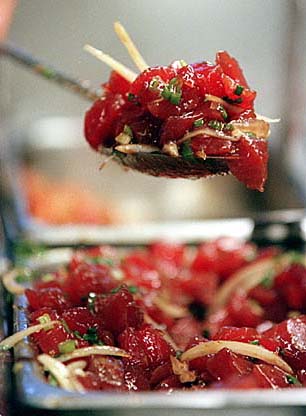
'Ahi Poke from Hawaii

'Ahi Poke from Hawaii
RECIPES 
A distinctly Hawaiian method of preparing and serving raw fish, poke has multiple variations but the most popular is spicy ahi poke with seaweed. You can also find salmon and octopus poke but if you’re a poke novice start with the basic ahi version. In Hawaii, it’s everywhere including buffet tables, luau’s, restaurant menus (usually served as “poke tacos”) and at the grocery store deli and fish counter.
In poke lore, preparations fall on two sides of a timeline, separated by Cook’s arrival to the Islands. (However, food historians debate when people actually began using the word “poke” to represent the fish dish; in her book The Food of Paradise, Rachel Laudan posits that it might have been as late as the 1960s, obviously much later than Cook’s arrival). Originally, “poke” was simply a Hawaiian word meaning “to cut crosswise into pieces.” As such, even now, it makes the definition of poke in culinary terms a little hard to pin down.
In 1991, poke was launched onto a public stage when chef Sam Choy started his poke contests. These contests gave home cooks and professional chefs alike venues in which to showcase recipes that ranged from pre-Cook styles (like one combination of wana [sea urchin] with opihi, limu kohu and inamona) to New Wave (i.e. Asian and Mediterranean-style ehu [short-tailed red snapper] and mango poke).

Modern poke typically consists of cubed ‘ahi (yellowfin tuna) sashimi marinated with sea salt, a small amount of soy sauce, inamona (roasted crushed candlenut), sesame oil, limu seaweed, and chopped chili pepper. Other variations' ingredients may include cured he’e (octopus), other types of raw tuna, raw salmon and other kinds of sashimi, sliced or diced Maui onion, furikake, hot sauce (such as sambal olek), chopped ‘ohi’a (tomato), tobiko (flying fish roe), ogo or other types of seaweed, and garlic.
The selection of condiments has been heavily influenced by Japanese and other Asian cuisines.

The traditional Hawaiian poke consists of fish that has been gutted, skinned, and deboned. It is sliced across the backbone as fillet, then served with traditional condiments. Some Hawaiians would suck the flesh off the bones and spit out the uneaten skin and bones. During the 19th century, recently introduced foreign vegetables such as tomatoes and onions were included, and now Maui onions are a very common ingredient.

Ingredients:
  • 2 pounds fresh tuna steaks, cubed
  • 1 cup soy sauce
  • 3/4 cup chopped green onions
  • 2 tablespoons sesame oil
  • 1 tablespoon toasted sesame seeds
  • 1 tablespoon crushed red pepper (optional)
  • 2 tablespoons finely chopped macadamia nuts
How to prepare it:
In a medium size non-reactive bowl, combine Ahi, soy sauce, green onions, sesame oil, sesame seeds, chili pepper, and macadamia nuts; mix well.
Refrigerate at least 2 hours before serving.

© Text and image: whatscookingmaui.com, honolulumagazine.com, Wikipedia, allrecipes.com

2 July 2011

Secrets of the Tribe

Secrets of the Tribe
FILM REVIEW 
Title: Secrets of the Tribe 
Director: José Padilha 
Writer: José Padilha 
Year: 2010 
Running time: 110 minutes 
Country: UK, Brazil 
Plot summary: 
The field of anthropology goes under the magnifying glass in this fiery investigation of the seminal research on Yanomami Indians. In the 1960s and '70s, a steady stream of anthropologists filed into the Amazon Basin to observe this "virgin" society untouched by modern life. Thirty years later, the events surrounding this infiltration have become a scandalous tale of academic ethics and infighting.

Secrets of the Tribe is a film by director José Padilha premiered at the 2010 Sundance Film Festival to critical acclaim. This documentary explores the allegations, first brought to light in the book Darkness in El Dorado, that anthropologists studying the Yanomami Indians in the 1960s and 70s engaged in bizarre and inappropriate interactions with the tribe, including sexual and medical violations. The film was nominated for a Grand Jury Prize.

© Text and image: IMDB

30 June 2011

The Tarahumara of Mexico

Tarahumara indians
PEOPLES OF THE WORLD 
Name: Tarahumara (Rarámuri) 
Living Area: Sierra Madre Occidental, Chihuaha State (Mexico) 
Population: <70,000 
Language: Tarahumara 
Comments:   
In Tarahumara language, the term rarámuri refers specifically to the males, females are referred to as muki (individually) or igomele (collectively).
Originally inhabitants of much of the state of Chihuahua, the Rarámuri retreated to the Copper Canyon in the Sierra Madre Occidental on the arrival of Spanish explorers in the sixteenth century. The area of the Sierra Madre Occidental which they now inhabit is often called the Sierra Tarahumara because of their presence.
Current estimates put the population of the Rarámuri in 2006 at between 50,000 and 70,000 people. Most still practice a traditional lifestyle, inhabiting natural shelters such as caves or cliff overhangs, as well as small cabins of wood or stone. Staple crops are corn and beans; however, many of the Rarámuri still practice transhumance, raising cattle, sheep, and goats. Almost all Rarámuri migrate in some form or another in the course of the year.
The Tarahumara language belongs to the Uto-Aztecan family. Although it is in decline under pressure from Spanish, it is still widely spoken
The Rarámuri religion is a mélange of indigenous customs and Roman Catholic Christianity, characterized by a belief that the afterlife is a mirror image of the mortal world, and that good deeds should be performed not for spiritual reward, but for the improvement of life on earth. In certain traditions (perhaps those more strongly based on pre-Columbian practice), the soul ascends a series of heavens, is reincarnated after each death, and after three lives becomes a moth on earth, which represents the final existence of the soul. When the moth dies, the soul dies completely. However, this end is not regarded as negative or a punishment, but merely as a continuation of the order of life. In Rarámuri cosmology, God has a wife who dwells with him in heaven, along with their sons, the so-called sukristo (from Spanish 'Jesucristo') and their daughters, the santi. These beings have a direct link with the physical world through Catholic iconography, respectively crucifixes and saint's medallions. The Devil's world is not necessarily evil, but is tainted through its ties with the Chabochi, or non-Rarámuri. The Devil is said to sometimes collaborate with God to arrange fitting punishments, and can be appeased through sacrifices. In some cases, the Devil can even be persuaded to act as a benevolent entity. The Devil and God are brothers (the Devil is the elder) who jointly created the human race. God, using pure clay, created the Rarámuri, whereas the Devil, mixing white ash with his clay, created the Chabochi. Thus, the Devil is as much protector and life-giver to the Chabochis as God is to the Rarámuri. The Rarámuri share with other Uto-Aztecan tribes a veneration for peyote.
The Rarámuri are also known for the brewing of tesguino, a corn-based beer brewed in ceramic jars, that features prominently in many Rarámuri religious rituals.

Known by their: long-distance running ability
The word for themselves, Rarámuri, means "runners on foot" or "those who run fast" in their native tongue according to some early ethnographers like Norwegian Carl Lumholtz, though this interpretation has not been fully agreed upon. With widely dispersed settlements, these people developed a tradition of long-distance running up to 120 miles (190 km) in one session, over a period of two days through their homeland of rough canyon country, for intervillage communication and transportation as well as to hunt. Before these long distance runs, they consume large quantities of corn beer (tesguino) which is very high in carbohydrate and very low on alcohol. The Tarahumara also use the toe strike method of running which is natural for bare-footed runners. The long-distance running tradition also has ceremonial and competitive aspects. Often, male runners kick wooden balls as they run in "foot throwing" competitions, and females use a stick and hoop. The foot throwing races are relays where the balls are kicked by the runners and relayed to the next runner while teammates run ahead to the next relay point. These races can last anywhere from a few hours for a short race to a couple of days without a break.

© Text and image: Wikipedia

28 June 2011

Ghana, Yesterday and Today

Ghana, Hier et Aujourd'hui
BOOK REVIEW 
Title: Ghana, Hier et Aujourd'hui (Ghana, Yesterday and Today)  
Author: Christiane Falgayrettes-Leveau and Christiane Owusu-Sarpong 
Year of publication: 2003 
Paperback: 424 pages 
Language: French and English
Synopsis:
Ghanaian metal-casters, goldsmiths, weavers, sculptors and ceramists have, from time immemorial, created objects glorifying political and spiritual power. Of varied origins - Asante, Fante, Ga, Ewe or Brong -, these pieces are the expression of ways of living and thinking that have been passed on from one generation to the next. For centuries, Ghana, previously known as the Gold Coast, based its economic influence on the trading of gold. Its colour and symbolism are intimately associated with the figure of the Asantehene - the King of the Asante. The jewellery belonging to the royal family and to palace officials are examples of sophisticated craftsmanship, while alongside these pieces, other insignia of high rank, such as the stools, are invested with a sacred dimension.
Ghanaian spiritual life, which accords special importance to relations with the deceased, has fostered the production of anthropomorphic terracottas, such as those unearthed at Koma-Bulsa and those of the Akan groups. Today's researchers posses descriptions of the latter dating from as early as 1601. This book presents a vast array of remarkable items exemplifying many different regional styles.
This book devotes a great deal of space to such contemporary creativity and highlights several outstanding examples, notably the work of Owusu-Ankomah, whose theme of bodies in movement embraces a resurgence or reworking of “traditional” motifs. It also presents the innovative approach adopted by Almighty God, whose paintings are teeming with symbols. His perpetually evolving art fuses text and images, and favours faithful portraiture or hyperrealism.
Thanks to contributions from today's foremost specialists, this reference work allows the reader not only to explore ancient kingdoms but also to discover modern Ghana and its rich cultural heritage.

©Text: Éditions Dapper

26 June 2011

Wooden movable-type printing of China

Wooden movable-type printing of China
UNESCO CULTURAL HERITAGE
One of the world’s oldest printing techniques, wooden movable-type printing is maintained in Rui’an County, Zhejiang Province, where it is used in compiling and printing clan genealogies. Men are trained to draw and engrave Chinese characters, which are then set into a type-page and printed. This requires abundant historical knowledge and mastery of ancient Chinese grammar. Women then undertake the work of paper cutting and binding, until the printed genealogies are finished. The movable characters can be used time and again after the type-page is dismantled. Throughout the year, craftspeople carry sets of wooden characters and printing equipment to ancestral halls in local communities. There, they compile and print the clan genealogy by hand. A ceremony marks the completion of the genealogy, and the printers place it into a locked box to be preserved. The techniques of wooden movable-type printing are transmitted through families by rote and word of mouth. However, the intensive training required, the low income generated, popularization of computer printing technology and diminishing enthusiasm for compiling genealogies have all contributed to a rapid decrease in the number of craftspeople. At present, only eleven people over 50 years of age remain who have mastered the whole set of techniques. If not safeguarded, this traditional practice will soon disappear.

Inscribed in 2010 on the List of Intangible Cultural Heritage in Need of Urgent Safeguarding

© Text: UNESCO, Image: Chinese Culture Ministry


24 June 2011

DOGON Exhibition at quai Branly

Dogon exhibition at Quai Branly
Exhibition: DOGON
Dates: 
5 April to 24 July 2011
Opening times: Tuesday, Wednesday and Sunday 11 to 19h, Thursday, Friday and Saturday 11 to 21h
Place: Musée du quai Branly, 37 quai Branly, Paris (France)
Entrance fee:  7 €
About the exhibition:
The DOGON exhibition presents Dogon culture and art history from the 10th century until today through more than 330 exceptional pieces from international collections and presented together for the first time in France.
Dogon area (Mali) art ranks among the best known art created by African cultures. The art from the Dogon area is considered as one of the best known art created by African cultures. Along with the masterpieces that have brought fame to Dogon art, the exhibition presents cultural and daily life objects that reflect the metaphysical and aesthetic concerns of the populations who made them. The typology of these objects, made with various and complex techniques, has rarely been revealed in light of the main pieces of the statuary ensemble.
Over ten centuries of settlement history, of artistic and cultural influences are thus explored through a unique ensemble of essential masterpieces and unseen daily life objects that reflect the progressive settlement of Dogon area and the richness of its stylistic.
The exhibition created by the musée du quai Branly shows the whole force of sculptural art developed by the Dogon, whether made of wood or metal, or expressed in large impressive pieces or powerful small objects.
In the 2000 m2 Garden Gallery, the DOGON exhibition is set in three great thematic parts representing the culture and art history of the Dogon people through a variety of artistic outputs.

INTRODUCTION: DOGON MIGRATIONS, ORIGINS AND HISTORY
Recent historical research on West Africa has revealed that populations in various areas of the region were not isolated. Migration waves, caravan itineraries, long-distance commercial trade and exchanges with other Bandiagara peoples had left behind an intricate network of contacts long before the arrival of Europeans. This is how the Dogon peoples could benefit from assets brought about by neighbouring civilizations.

FIRST PART: STATUARY STYLES IN DOGON AREA
Beyond the apparent unity of a common identity built over the centuries, the statues in this part of the exhibition reveal the remarkable creativity of Dogon people and the great diversity of its artistic production. It explores the underlying complexity of Dogon area, falsely perceived as a cultural continuum.
Divided in different styles corresponding to diverse groups of people or geographical zones, 133 exceptional sculptures exemplify this wealth of diversity: Djennenke, N’Duleri, Tombo, Niongom and Tellem, Gogon-Mande, Tintam, Bombou Toro, Kambari, Komakan, and the styles of the Séno plain and escarpment.
Upon their arrival in the Bandiagara plateau, the Dogon encountered groups already living in the region and having developed a material culture.
In the cliff’s area, Tellem sculptures and textiles found in the sanctuaries coexist with Niongom and Mande Dogon art, while Djennenke sculptures in the North of the plateau and Tombo pieces in its centre derive from different migration waves.

SECOND PART: ANTHROPOLOGIST FASCINATION: PAINTINGS AND MASKS
In the West, the emerging interest for Dogon art, from the 1893 Bandiagara conquest onwards is, above all, a scientific pursuit, fully expressed by the Dakar-Djibouti Mission (1931-1933). This part of the exhibition explores the institutional methods used during the gathering of the first collections, which were the first step towards spreading knowledge on Dogon art in the West.
Two figures of the anthropological imagination, Louis Desplagnes and Marcel Griaule, exemplify how Dogon art captured European curiosity and taste.

* Rupestral paintings
In 1907, in his book entitled Le plateau central nigérien, Louis Desplagnes tells about how he started the very first research on Dogon area arts and cultures after an expedition in the Bandiagara region. He unveiled cave art, remarkable for the liveliness and energy of its expression. His collections were then handed to the ethnography Museum of the Trocadéro.
About twenty rupestral paintings are presented in this subsection.

* Masks
In Masques dogons (1938), Marcel Griaule introduces a very precise ethnographic typology.
Favoured research subject, the Dogon mask plays a role in laying the foundations of this specific ethnological practice. 35 Dogon masks recall the classification proposed in his book.

THIRD PART: VESSELS OF THE SACRED, COLLECTION ITEMS
Along with scientific endeavours and new field research missions, the fascination for Dogon objects and sculptures is increasing. Collectors are not only seeking statuary Dogon objects, but also unique objects. A 35-minutes montage of excerpts from Jean Rouch’s Dama d’Ambarra (1974) adds to the first part of this sequence.

The 140 objects exposed in the last section reveal that Dogon sculptors tend to express the original myth when creating daily life objects and architectural components such as jewels, bronze and iron objects, pulleys, doors, locks, seats, headrests, animal sculptures, altars, arches, cups and plates. They evoke the same magical and theological subjects as the sculptures displayed in the first part.

At the end of the itinerary, the Pillars of Togu Na, the “House of Words” –open-construction built at the centre of Dogon villages - lead to the musée du quai Branly’s Djennenke statue, essential masterpiece of Dogon area art.

© Text and image: www.quaibranly.fr