Showing posts with label Hawaii. Show all posts

3 February 2012

Hawaiian hula

MUSIC AND DANCE
Name: Hula
Origin: Hawaii (Polynesia, USA)
Comments:
Hula is a dance form accompanied by chant (oli) or song (mele). It was developed in the Hawaiian Islands by the Polynesians who originally settled there. The hula dramatizes or portrays the words of the oli or mele in a visual dance form.
There are many sub-styles of hula, with the main two categories being Hula 'Auana and Hula Kahiko.
There are also two main positions of a hula dance - either sitting (noho dance) or standing (luna dance). Some dances utilize both forms.
Hula is taught in schools or groups called hālau. The teacher of hula is the kumu hula, where kumu means source of knowledge, or literally just teacher. Often you will find that there is a hierarchy in hula schools - starting with the kumu (teacher), alaka'i (leader), kokua (helpers), and then the 'olapa (dancers) or haumana (students). Most, if not all, hula hālau(s) have a permission chant in order to enter wherever they may practice. They will collectively chant their entrance chant, then wait for the kumu to respond with the entrance chant, once he or she is finished, the students may enter. One well known and often used entrance or permission chant is Kunihi Ka Mauna.
Hula dancing is a complex art form, and there are many hand motions used to represent the words in a song or chant. For example, hand movements can signify aspects of nature, such as the swaying of a tree in the breeze or a wave in the ocean, or a feeling or emotion, such as fondness or yearning. Foot and hip movements often pull from a basic library of steps including the kaholo, ka'o, kawelu, hela, 'uwehe, and 'ami.

Legendary origins
There are various legends surrounding the origins of hula.
According to one Hawaiian legend, Laka, goddess of the hula, gave birth to the dance on the island of Moloka’i, at a sacred place in Ka’ana. After Laka died, her remains were hidden beneath the hill Pu’u Nana.
Another story tells of Hi’iaka, who danced to appease her fiery sister, the volcano goddess Pele. This story locates the source of the hula on Hawai’i, in the Puna district at the Hā’ena shoreline. The ancient hula Ke Ha’a Ala Puna describes this event.
Another story is when Pele, the goddess of fire was trying to find a home for herself running away from her sister Namakaokaha'i (the goddess of the oceans) when she finally found an island where she couldn't be touched by the waves. There at chain of craters on the island of Hawai'i she danced the first dance of hula signifying that she finally won.
One story is that Pele asked Laka to amuse her because Pele was bored. So right away Laka got up and began to move gracefully, acting out silently events they both knew. Pele enjoyed this and was fascinated. Thus Hula was born.
American Protestant missionaries, who arrived in 1820, denounced the hula as a heathen dance. The newly Christianized ali’i (royalty and nobility) were urged to ban the hula—which they did. However, many of them continued to privately patronize the hula. By the 1850s, public hula was regulated by a system of licensing.
The Hawaiian performing arts had a resurgence during the reign of King David Kalākaua (1874–1891), who encouraged the traditional arts. With the Princess Liliuokalani who devoted herself to the old ways, as the patron of the ancients chants (mele, hula), she stressed the importance to revive the diminishing culture of their ancestors within the damaging influence of foreigners and modernism that was forever changing Hawaii.
Hula changed drastically in the early 20th century as it was featured in tourist spectacles, such as the Kodak Hula Show, and in Hollywood films. However, a more traditional hula was maintained in small circles by older practitioners. There has been a renewed interest in hula, both traditional and modern, since the 1970s and the Hawaiian Renaissance.

Hula Kahiko
Ancient hula, as performed before Western encounters with Hawai’i, is called kahiko. It is accompanied by chant and traditional instruments.
Hula kahiko, often defined as those hula composed prior to 1893 which do not include modern instruments, encompasses an enormous variety of styles and moods, from the solemn and sacred to the frivolous. Many hula were created to praise the chiefs and performed in their honor, or for their entertainment. Types of hula kahiko include ‘āla’apapa, ha’a, ‘olapa, and many others.
Many hula dances are considered to be a religious performance, as they are dedicated to or honoring a Hawaiian goddess or god. As was true of ceremonies at the heiau, the platform temple, even a minor error was considered to invalidate the performance. It might even be a presage of bad luck or have dire consequences. Dancers who were learning to do such hula necessarily made many mistakes. Hence they were ritually secluded and put under the protection of the goddess Laka during the learning period. Ceremonies marked the successful learning of the hula and the emergence from seclusion.
Hula kahiko is performed today by dancing to the historical chants. Many hula kahiko are characterized by traditional costuming, by an austere look, and a reverence for their spiritual roots.
Hawaiian history was oral history. It was codified in genealogies and chants, which were memorized and passed down. In the absence of a written language, this was the only available method of ensuring accuracy. Chants told the stories of creation, mythology, royalty, and other significant events and people.
Traditional female dancers wore the everyday pā’ū, or wrapped skirt, but were topless. Today this form of dress has been altered. Dancers might also wear decorations such as necklaces, bracelets, and anklets, as well as many lei (in the form of headpieces (leipo'o), necklaces, bracelets, and anklets (kupe'e)).
Traditional male dancers wore the everyday malo, or loincloth. They also wore necklaces, bracelets, anklets, and lei.
The materials for the lei worn in performance were gathered in the forest, after prayers to Laka and the forest gods had been chanted.
The lei and tapa worn for sacred hula were considered imbued with the sacredness of the dance, and were not to be worn after the performance. Lei were typically left on the small altar to Laka found in every hālau, as offerings.
Instruments and implements:
Ipu—single gourd drum
Ipu heke—double gourd drum
Pahu—sharkskin covered drum; considered sacred
Pūniu—small knee drum made of a coconut shell with fish skin (kala) cover
‘Ili’ili—water-worn lava stone used as castanets
‘Ulī’ulī—feathered gourd rattles (also ‘ulili)
Pū’ili—split bamboo sticks
Kāla’au—rhythm sticks
The dog's-tooth anklets sometimes worn by male dancers could also be considered instruments, as they underlined the sounds of stamping feet.

Hula ‘auana
Hula as it evolved under Western influence, in the 19th and 20th centuries, is called ‘auana (a word that means "to wander or drift"). It is accompanied by song and Western-influenced musical instruments such as the guitar, the ‘ukulele, and the double bass.
The mele of hula ‘auana are generally sung as if they were popular music. A lead voice sings in a major scale, with occasional harmony parts.
The primary influences were Christian morality and melodic harmony. Hula ‘auana still tells or comments on a story, but the stories may include events since the 1800s. The subject of the songs is as broad as the range of human experience. People write mele hula ‘auana to comment on significant people, places or events or simply to express an emotion or idea.
The costumes of the women dancers are less revealing and the music is heavily Western-influenced.
The musicians performing hula ‘auana will typically use portable acoustic stringed instruments.
‘Ukulele—four-, six- or eight-stringed, used to maintain the rhythm if there are no other instruments
Guitar—used as part of the rhythm section, or as a lead instrument
Steel guitar—accents the vocalist
Bass—maintains the rhythm
Occasional hula ‘auana call for the dancers to use implements, in which case they will use the same instruments as for hula kahiko. You will often see a hula 'auana with the dancers using ‘Ulī’ulī (feathered gourd rattle).

© Text: Wikipedia / Photo: Jordi Canal-Soler


15 August 2011

Hawaiian spam musubi

Hawaiian spam musubi
RECIPES 
Spam musubi is appreciated for its taste and portability. A single musubi, usually wrapped in cellophane, can be purchased at small deli-type convenience stores (including 7-Eleven stores) all over the Hawaiian islands, ranging in price from $1 to $2. The 7-Eleven stores include a wide variety of flavors, including a regular Spam musubi and a deluxe Spam musubi (with furikake and a scrambled egg). Other variations include a musubi made with fried shrimp, chicken katsu, or pork cutlet instead of Spam.
Spam musubi acrylic rice molds are available at many kitchen stores in Hawaii. These molds are a few inches deep with a width and breadth that matches a slice of Spam.
By the way, United States President Barack Obama, who was born and raised in Hawaii, is a noted fan of spam musubi.
Recipes vary but typically slices of spam first are grilled, sometimes with a light teriyaki flavor. An acrylic mold is then placed over a sheet of nori and rice is pressed into the mold. The grilled spam is placed over the rice in the mold and the mold is removed. The nori is then wrapped over the top and around the musubi.

Ingredients:
  • 2 cups uncooked short-grain white rice
  • 2 cups water
  • 6 tablespoons rice vinegar
  • 1/4 cup soy sauce
  • 1/4 cup oyster sauce
  • 1/2 cup white sugar
  • 1 (12 ounce) container fully cooked luncheon meat (e.g. Spam)
  • 5 sheets sushi nori (dry seaweed)
  • 2 tablespoons vegetable oil
How to prepare it:
Soak uncooked rice for 4 hours; drain and rinse.
In a saucepan bring 2 cups water to a boil. Add rice and stir. Reduce heat, cover, and simmer for 20 minutes. Stir in rice vinegar, and set aside to cool.
In a separate bowl, stir together soy sauce, oyster sauce, and sugar until sugar is completely dissolved. Slice luncheon meat lengthwise into 10 slices, or to desired thickness, and marinate in sauce for 5 minutes.
In a large skillet, heat oil over medium high heat. Cook slices for 2 minutes per side, or until lightly browned. Cut nori sheets in half and lay on a flat work surface. Place a rice press in the center of the sheet, and press rice tightly inside. Top with a slice of luncheon meat, and remove press. Wrap nori around rice mold, sealing edges with a small amount of water. (Rice may also be formed by hand in the shape of the meat slices, 1 inch thick.) Musubi may be served warm or chilled.

© Text and image: whatscookingmaui.com, Wikipedia, allrecipes.com

4 July 2011

'Ahi Poke from Hawaii

'Ahi Poke from Hawaii
RECIPES 
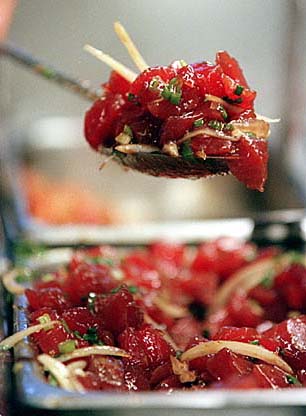
A distinctly Hawaiian method of preparing and serving raw fish, poke has multiple variations but the most popular is spicy ahi poke with seaweed. You can also find salmon and octopus poke but if you’re a poke novice start with the basic ahi version. In Hawaii, it’s everywhere including buffet tables, luau’s, restaurant menus (usually served as “poke tacos”) and at the grocery store deli and fish counter.
In poke lore, preparations fall on two sides of a timeline, separated by Cook’s arrival to the Islands. (However, food historians debate when people actually began using the word “poke” to represent the fish dish; in her book The Food of Paradise, Rachel Laudan posits that it might have been as late as the 1960s, obviously much later than Cook’s arrival). Originally, “poke” was simply a Hawaiian word meaning “to cut crosswise into pieces.” As such, even now, it makes the definition of poke in culinary terms a little hard to pin down.
In 1991, poke was launched onto a public stage when chef Sam Choy started his poke contests. These contests gave home cooks and professional chefs alike venues in which to showcase recipes that ranged from pre-Cook styles (like one combination of wana [sea urchin] with opihi, limu kohu and inamona) to New Wave (i.e. Asian and Mediterranean-style ehu [short-tailed red snapper] and mango poke).

Modern poke typically consists of cubed ‘ahi (yellowfin tuna) sashimi marinated with sea salt, a small amount of soy sauce, inamona (roasted crushed candlenut), sesame oil, limu seaweed, and chopped chili pepper. Other variations' ingredients may include cured he’e (octopus), other types of raw tuna, raw salmon and other kinds of sashimi, sliced or diced Maui onion, furikake, hot sauce (such as sambal olek), chopped ‘ohi’a (tomato), tobiko (flying fish roe), ogo or other types of seaweed, and garlic.
The selection of condiments has been heavily influenced by Japanese and other Asian cuisines.

The traditional Hawaiian poke consists of fish that has been gutted, skinned, and deboned. It is sliced across the backbone as fillet, then served with traditional condiments. Some Hawaiians would suck the flesh off the bones and spit out the uneaten skin and bones. During the 19th century, recently introduced foreign vegetables such as tomatoes and onions were included, and now Maui onions are a very common ingredient.

Ingredients:
  • 2 pounds fresh tuna steaks, cubed
  • 1 cup soy sauce
  • 3/4 cup chopped green onions
  • 2 tablespoons sesame oil
  • 1 tablespoon toasted sesame seeds
  • 1 tablespoon crushed red pepper (optional)
  • 2 tablespoons finely chopped macadamia nuts
How to prepare it:
In a medium size non-reactive bowl, combine Ahi, soy sauce, green onions, sesame oil, sesame seeds, chili pepper, and macadamia nuts; mix well.
Refrigerate at least 2 hours before serving.

© Text and image: whatscookingmaui.com, honolulumagazine.com, Wikipedia, allrecipes.com

5 April 2011

Blackburn polynesia collection

Title: Polynesia: The Mark and Carolyn Blackburn Collection of Polynesian Art
Author: Adrienne Kaeppler
Year of publication: 2010
Paperback: 448 pages
Language: English
Synopsis:
The visual arts of Polynesia offer a richly diverse and relatively little known body of work, covering an enormous geographical area yet linked by shared artistic conventions. The collection of Mark and Carolyn Blackburn, one of the greatest private collections of Polynesian art in the world, encompasses this broad field of artistic endeavor. It features both ceremonial and functional traditional forms in diverse media, from delicate ivory ornaments and decorated barkcloth to formidable weaponry and imposing sculpture in coral, wood, and stone.
The geographic spread of the collection is vast, covering the Pacific Ocean from Hawai‘i to Rapa Nui (Easter Island) to ‘Aotearoa (New Zealand), and the many islands in between. Many of the pieces have noteworthy historical antecedents, such as items associated with the eighteenth-century voyages of Captain Cook, and the Dupetit-Thouars material from the Marquesas, first collected by the nineteenth-century French admiral of that name.
In this book, for the first time, these unique works of art are on display, fully described and annotated, for the enjoyment and appreciation of scholars, collectors, and interested readers alike. Selected paintings, drawings, engravings, and photographs from the Blackburn collection give context to the artifacts and essays. Items from each geographic and cultural area are described within their cultural and historical context: ‘Aotearoa (New Zealand), the Austral Islands, the Cook Islands, Fiji, Futuna, the Gambier Islands, Hawai‘i, Malden, the Marquesas Islands, Niue Island, Nukuoro Island, Rapa Nui (Easter Island), Rennell Island, Rotuma Island, Samoa, Tahiti, Takuu, Tokelau, Tonga, and the Tuamotu Islands.
In Polynesia, the visual arts and their associated objects serve as physical representations of the underlying aesthetic, social, and religious aspects of the island cultures. In some cases, these eloquent objects may be all that remains to speak of these once-living traditions. This publication allows these remarkable works to communicate directly with the modern viewer.
Adrienne Kaeppler is curator of Oceanic ethnology at the Smithsonian Institution in Washington, D. C. She has carried out field research in Tonga, Hawai‘i, and elsewhere in Polynesia. Renowned for her work on the ethnography and collections from Cook’s voyages, she continues to focus on connections between social structure and the visual and performing arts.

©Text: University of Hawai’i Press

28 April 2010

Lei Niho Palaoa

Name: Lei Niho Palaoa
Origin: HawaiiPolynesia
Date: 200 BC - AD 800
Museum: Bishop Museum, Honolulu, Hawaii (US) Material: Ivory (spermwhale), hair, textile, plant (olona) 
Dimensions: 26 x 14.2 cm Comments:
Hawaiian society under the ‘Aikapu system was stratified according to rank. An individual’s rank was not determined by wealth or gender, but by genealogy. Those of the highest rank could trace their genealogy all the way back to the beginning of time, to the very first organism to inhabit the earth, even to the primordial darkness preceding all life. These genealogies were recorded in chants called
ko‘ihonua that glorified Ali‘i bloodlines, ancestors, and their decedents.
Ali‘i, like other strata of Hawaiian society, were not all of similar rank. The highest Ali‘i were the Mō‘ī, or supreme rulers. They were often nī‘aupi‘o chiefs, having being conceived through the union of high ranking siblings. These nī‘aupi‘o chiefs were considered to be Akua (Gods) on earth, and as such, they had to keep strict kapu, or taboos, least the welfare of their people and lands be compromised. Also, because ruling was a kuleana (responsibility, right), many chiefs would go to great lengths to ensure their kapu were kept. For example, for those whose kapu forbade their shadow falling on another human, they would often leave their kauhale (housing complex) only after the sun had gone down so that their shadow could not be cast. Ruling in Hawai‘i was not just about luxury, as the Mō‘ī had an inter-dependent relationship with the maka‘āinana (common people). The commoners provided the resources that the Mō‘ī would use to mālama their people and the Gods.
There might be one Ali‘i Nui ruling over an entire island, or several each with their own moku (large land division within an island). Lesser Ali‘i, known as kaukau ali‘i might rule over an ahupua‘a, smaller land division, or an ‘ili, an even smaller land division within an ahupua‘a. Unlike the Ali‘i Nui, the Kaukau Ali‘i often did not have strict kapu. In fact, many Kaukau Ali‘i were not of much higher rank than the konohiki, or resource managers, who dealt directly with the maka‘āinana.
One important symbol of rank for the highest Ali‘i was the lei niho palaoa, a whale tooth pendant. The carved hook pendant is strung on thousands of finely braided strands of human hair. These significant lei were worn by Ali‘i of both genders. These whale teeth were collected from carcass that would wash ashore at specific places in the islands. These wahi pana (sacred places) were considered important areas to control in order to have access to the mana that these items brought. Control over these spots, like Kualoa on O‘ahu, might mean control over the entire island.

The strands of hair of this particular necklace are braided in varying thicknesses. A knot of olona (Touchardia latifolia) used to bind the strands of hair together with the pendent can be seen at this junction. The olona tying cords are wrapped with black ribbon. Through Queen Emma's will, this and many other cultural objects, were passed to Princess Pauahi, with the provision that it go to a museum in Hawaii's future.

© Text and image: www.bishopmuseum.org and www.hawaiialive.org

26 April 2010

Hawaiian beef stew with poi

What's poi?
Poi is made from the popular hawaiian taro plant (Colocasia esculenta), the 14th most cultivated crop on earth. Taro is cultivated both in the dry uplands and in marshy land irrigated by streams. The planters of wetland taro built walls of earth reinforced with stone to enclose the taro patch, or lo`i.
Although taro is eaten around the world, only Hawaiians make poi. Traditionally they cooked the starchy, potato-like taro root, or corm, for hours in an underground oven called an imu. Then they pounded the taro corms on large flat boards called Papa ku`i`ai, using heavy stone poi pounders called pohaku ku`i `ai. The taro was pounded into a smooth, sticky paste called pa`i`ai, then stored air tight in ti leaf bundles and banana sheaths for storage or future trading. By slowly adding water to the pa`i`ai, which was then mixed and kneaded, the perfect poi consistency was created. Poi was traditionally enjoyed with fresh fish, seaweed, breadfruit and sweet potato, an incredibly tasty and nutritious meal. It was eaten with fingers. Some times it was left to ferment a bit, giving it a unique, slightly sour taste.
The bowl of poi was considered so important and sacred a part of daily Hawaiian life that whenever a bowl of poi was uncovered at the family dinner table, it was believed that the spirit of Haloa, the ancestor of the Hawaiian people, was present. Because of that, all conflict among family members had to come to an immediate halt.


The recipe: Hawaiian beef stew thickened with poi 
(by http://www.poico.com/)
Hawaiian beef stew thickened with poi is a classic local dish: a basic beef stew thickened with poi instead of the usual flour-water mixture.
•2 to 3 pounds of stew beer
•Flour
•Salt
•Pepper
•Vegetable oil, or bacon drippings
•Raw vegetables (carrots, onions, potatoes, other root vegetables)
•1 to 2 cups Tomatoes, peeled and seeded
•2 teaspoons Hawaiian salt (or kosher salt)
•1 cup poi
Dredge 2-3 pounds of stew beef lightly in a blend of flour, salt and pepper. Brown in vegetable oil or bacon drippings in deep, heavy-bottomed Dutch oven. Cover with water, bring to a boil, turn down heat and simmer for an hour. Add 2-3 cups of raw vegetables: chunks of carrot, onion, potato and other root vegetable (chunks of peeled, boiled taro are good, too). Add 1-2 cups of peeled, seeded tomatoes (may be frozen or canned) and 2 teaspoons Hawaiian salt (or kosher salt). More water may be added, if necessary. Simmer one hour. Just before serving, add 1 cup poi to thicken stew: stir and add more poi if needed. up to 2 cups. Serve hot over steamed Japanese-style rice. Pass Hawaiian chili pepper water (tiny red-hot chilies steeped in boiling water, then bottled) and trimmed green onions for those who like a little fire.