Showing posts with label Mexico. Show all posts

28 January 2012

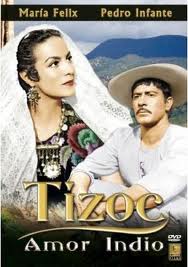
Tizoc

FILM REVIEW 
Title: Tizoc 
Year: 1957 
Director: Ismael Rodríguez 
Writer: Manuel Ojeda, Carlos Orellana 
Cast: Pedro Infante, María Félix 
Running time: 109 minutes   
Country: Mexico 
Plot summary: 
Some people subtitle this movie as Indian Love; the reason is perfectly clear. Tizoc (Pedro Infante) is an Indian who works hard while the rest of the indians envy and even hate him. One day he meets the most beautiful woman on earth, María (María Félix) so takes her as the Virgin of the local church.
The woman is member of a wealthy country-family, one of the richest of the region. However, the wealthy, beautiful and Virgin-like woman befriends the poor but hard working Indian.
One day Tizoc is hurt by another Indian. María witnesses this and gives him a white handkerchief to wipe his blood. ¡Alas! The man goes crazy. In fact she ignores that to offer a white handkerchief to an Indian of this region means to accept him as the husband.
Now Tizoc works harder to build the house where he and María should come to live. No matter what, Tizoc won't listen to anybody, not even the local priest: he is convinced that María wants to be his wife.
After a few days he comes to believe that María has made a fool of him. So, angry, he kidnaps her and takes her to a mountain. Even the Army comes after him to rescue the wealthy woman, but also the other indians who hate Tizoc.
In captivity María talks to Tizoc and he realizes his misunderstanding. So he lets her go free. But then one of the other indians, trying to kill Tizoc, shoots her an arrow to kill her. The saddest Tizoc takes out the arrow from her breast and plunges it into his own chest.
Perhaps the most famous passage of this movie is when Tizoc sings her Te quiero más que a mis ojos. Te quiero más que a mis ojos. Pero quiero más a mis ojos Pero quiero más a mis ojos porque mis ojos te vieron (I love you more than my eyes, I love you more than my eyes. But I love more my eyes, but I love more my eyes because my eyes saw you)
Moved, she begins to weep. Then, when he realizes that she's crying, with a rock hits the mouth that has made her cry.
On April, 15th, 1957 Pedro Infante died on a plane crash. However, months later his character as Tizoc got him the Berlin's Silver Bear for Best Actor (while Twelve Angry Men got the Golden Bear)

© Text and image: Wikipedia and IMDB


31 December 2011

Rough Magic

FILM REVIEW 
Title: Rough Magic 
Year: 1995 
Director: Clare Peploe 
Writer: James Hadley Chase, Robert Mundi, William Brookfield, Clare Peploe 
Running time: 100 minutes   
Country: USA 
Plot summary: 
Set in the 1950s, Rough Magic tells the story of what happens when a pretty apprentice magician goes to Mexico to escape her fiancé, a wealthy politician, and to find a Mayan shaman who will teach her ancient principles of magic. She is being trailed by a detective hired by her fiancé. He's a former photojournalist traumatized by what he saw in Hiroshima. The photojournalist joins her in the search for the Mayan shaman, and falls in love with her; the feeling is not reciprocated. When she finds the shaman, she drinks a potion which empowers her to do magic. The potion has life-changing effects on her and her relationship with her companion. They have strange experiences which are brought about by magic. 

© Text and image: Wikipedia and IMDB 

28 September 2011

Carlos Castaneda

Carlos Castaneda, ETHNIKKA blog for human cultures knowledge
ANTHROPOLOGISTS OF THE WORLD 
Carlos Castaneda (1925 - 1998) 
Carlos (César Salvador Arana) Castaneda (anglicized from Castañeda; 25 December 1925 – 27 April 1998) was a Peruvian-born American anthropologist and author.
Starting with The Teachings of Don Juan in 1968, Castaneda wrote a series of books that describe his training in sorcery. The books, narrated in the first person, relate his experiences under the tutelage of a Yaqui "Man of Knowledge" named don Juan Matus. His 12 books have sold more than 8 million copies in 17 languages. Critics have suggested that they are works of fiction; supporters claim the books are either true or at least valuable works of philosophy and descriptions of practices which enable an increased awareness.
Castaneda withdrew from public view in 1973 to work further on his inner development, living in a large house with three women ("Fellow Travellers of Awareness") who were ready to cut their ties to family and changed their names. He founded Cleargreen, an organization that promoted tensegrity, purportedly a traditional Toltec regimen of spiritually powerful exercises.

His works 
Castaneda's first three books — The Teachings of Don Juan: A Yaqui Way of Knowledge; A Separate Reality; and Journey to Ixtlan — were written while Castaneda was an anthropology student at the University of California, Los Angeles (UCLA). He wrote these books as his research log describing his apprenticeship with a traditional "Man of Knowledge" identified as don Juan Matus, a Yaqui Indian from northern Mexico. Castaneda was awarded his bachelor's and doctoral degrees based on the work described in these books. He also says the sorcerer bequeathed him the position of nagual, or leader of a party of seers. He also used the term nagual to signify that part of perception which is in the realm of the unknown yet still reachable by man, implying that, for his party of seers, Don Juan was a connection in some way to that unknown. Castaneda often referred to this unknown realm as nonordinary reality, which indicated that this realm was indeed a reality, but radically different from the ordinary reality experienced by human beings.
The term nagual has been used by anthropologists to mean a shaman or sorcerer who is believed capable of shapeshifting into an animal form, or to metaphorically "shift" into another form through magic rituals, shamanism and experiences with psychoactive drugs (e.g., peyote and jimson weed - Datura stramonium).
In 1974 his fourth book, Tales of Power, was published. This book ended with Castaneda leaping from a cliff into an abyss, and signaled the end of his apprenticeship under the tutelage of Matus. Castaneda continued to be popular with the reading public with subsequent publications.

© Text and photo: Wikipedia

26 September 2011

Tarahumaran Tesgüino

WORLD RECIPES 
Tesgüino is a corn beer made by the Tarahumara Indians of Sierra Madre in Mexico. The Tarahumara regard the beer as sacred, and it forms a significant part of their society. Anthropologist John Kennedy reports that "the average Tarahumara spends at least 100 days per year directly concerned with tesgüino and much of this time under its influence or aftereffects".
The general Tarahumara term for an alcoholic beverage is "Sugíki"; "batári" is used when the beer is specifically made from corn or lichen flour; "paciki" is used when the beer is made from fresh corn stalks. While tesgüino made from corn is considered the most sacred, the Tarahumara also make beer from agave and wheat, as well as other alcoholic beverages made from fruits such as peaches, berries, crab apples, cactus fruits, and Mesquite seeds.

From the NPR Radio Programme:
For the Tarahumara, the astringent, homemade corn beer is a sacred social lubricant — and during Easter week, or "semana santa," the entire town of Norogachi turns into a giant brewpub. Corn kernels are soaked, ground up, boiled and spiked with a local grass to help the mixture ferment.
The Tarahumara (who refer to themselves as the Raramuri) are a linguistic group of 120,000 who share a common language and have preserved their culture through isolation and resistance. For them, beer is an elixir for healing, a barter item and a divine beverage.
"God taught the Raramuri how to make corn beer," says Guadalupe Espino Palma, the traditional governor of the Norogachi district. "We make offerings of tesguino to God himself, and He drinks it also. We use tesguino for dancing, and we enjoy drinking it." Even getting drunk is a spiritual act, he explains.
Bill Merrill, a Smithsonian Institution anthropologist who's spent 30 years studying and working with the Tarahumara, says the tesguino chases out the "large souls" within, leaving only the "little souls." "And so when people get drunk that's why they act like children," he says, "Because the souls that are controlling their actions are the little souls, like little children."
The Raramuri also believe they are God's chosen people, and that their mountain home is the center of the world. In their colorful parades and festivals, they freely use Christian iconography to represent the struggle between the Raramuri and the outside world.
Still, the outside world is slowly creeping into traditional life — looking for work in the cities, modern comforts can be seductive. "It's easier to get drunk on a couple of beers or a bottle of tequila than to make tesguino and share it with everyone," says Carlos Palma Batista, director of the Raramuri Education Initiative, a Ford Foundation project to help preserve native language and knowledge.
The Easter celebrations of the Raramuri are a big draw for tourists. By custom, participants will drink, dance, drum and carouse for as long as the tesguino holds out, whether two days or two weeks. Spring planting will wait.
And during this corn beer communion, in place of "happy Easter," the Raramuri will say to one another "bosasa" — "fill up, be satisfied, be contented."

Ingredients:
  • 8 quarts water
  • 1 pound germinated corn
  • 2 cups brown sugar
  • 8 whole allspice or cloves
  • ale yeast
How to prepare it:
To germinate corn, soak 2 pounds of corn in cold water for 24 hours, then transfer it to a colander for germination. Spray cold water on the corn and turn it in the colander twice a day to prevent it from drying out or getting moldy. Within 5 days, the corn should have germinated to the point that sprouts have reached 2 inches in length. When they do, remove the corn from the colander and allow it to dry in the sun or in the oven on its lowest setting.
Crush the corn coarsely then place it in the brewpot with the water and let it sit for 1 hour.
Bring the wort to a boil, then add the sugar.
Reduce the heat and allow the wort to simmer for 3 hours stirring regularly.
Add the spices at the and of the boil and allow the wort to sit for 1 hour.
Strain the wort into a fermenter once cool and pitch the yeast.
Ferment at 65º-70ºF for 5 days, then rack to a secondary and allow to ferment for 2 more weeks.
Bottle with 1 teaspoon corn sugar per bottle for priming and allow to condition for 2 weeks before drinking.

© Text and image: www.npr.org, Wikipedia, Stephen Harrod Buhner's "Sacred and Herbal Healing Beers" (Siris Books, 1998)

12 September 2011

Mexican pinole

WORLD RECIPES 
Pinole is a Spanish translation of an Aztec word for a coarse flour made from ground toasted maize kernels, often in a mixture with a variety of herbs and ground seeds, which can be eaten by itself or be used as the base for a beverage. In southeastern Mexico and in Central America this food and beverage is known as pinol or pinolillo, considered the national beverage of Nicaragua.
Herbs and flavorings added to pinole include ground mustard seeds, ground chia seeds, ground cacao, sugar, cinnamon, vanilla, achiote, and other grasses and annual herbs. The mixture is sometimes beaten with water to make a hot or cold beverage (also called pinole), or sometimes cooked with water to make an edible mush.
In parts of central Mexico, groups of rowdy youths traditionally went from house to house during Carnival to demand pinole, which they were served without water (and frequently mixed with Chili pepper to make it even more difficult to swallow). This custom may have given rise to the popular saying, El que tiene más saliva, traga más pinole ("Whoever has the most saliva, swallows the most pinole"; in other words, whoever has the most skill for a particular job will accomplish the most).

Pinole describes any of a variety of forms of parched or roasted corn, ground into a flour and combined with water and some spices or sugar. It can be made into a drink, an oatmeal-like paste, or baked to form a more-portable "cake."

Ingredients
  • 1/2 cup cornmeal, ground as fine as possible
  • 1/2 tsp ground cinnamon
  • 1 Tbsp brown sugar, honey, or agave nectar
  • chia seeds (optional)
How to prepare it:
Toast the cornmeal in a skillet over medium heat, stirring often, until it turns light brown, about 5 minutes. Transfer to a bowl, mix in cinnamon, and sweetener or other spices, and desired amount of water.
If you add just a few tablespoons of water instead and mix, you get an oatmeal-like consistency that can be eaten with a spoon. Alternatively, you can bake the paste at 350 degrees Fahrenheit for 10-15 minutes until it has the texture of a brownie.

© Text and image: Matt Frazier (www.nomeatathlete.com)


8 September 2011

The Yaqui of Mexico

Yaqui or Yoreme deer dancers, ETHNIKKA blog for human culture knowledge
PEOPLES OF THE WORLD 
Name: Yaqui (or Yoreme) 
Living Area: Sonora State (Mexico), and Arizona State (USA
Population: approx. 23.000 
Language: Yaqui 
Comments:    
The Yaqui or Yoreme are a Native American tribe who originally lived in the valley of the Río Yaqui in the northern Mexican state of Sonora. Many Yaqui still live in their original homeland, but some live in Arizona as a result of wars between the Yaqui and the Mexican government. The Yaqui call themselves Yoreme, the Yaqui word for person (yoemem or yo'emem meaning "people"). Their language is one of 30 in the Uto-Aztecan family. The Yaqui call their homeland Hiakim, from which the name "Yaqui" is derived. They may also describe themselves as Hiaki Nation or Pascua Hiaki, meaning "The Easter People", as most had converted to Catholicism under Jesuit influence in colonial Mexico.
In the past, the Yaqui subsisted on agriculture, growing corn, beans, and squash (like many of the natives of the region). The Yaqui who lived in the Río Yaqui region and in coastal areas of Sonora and Sinaloa fished as well as farmed. The Yaqui also made cotton products. The Yaqui have always been skillful warriors. The Yaqui Indians have been historically described as quite tall in stature.
The Yaqui conception of the world is considerably different from that of their European-Mexican and European-American neighbors. For example, the world (in Yaqui, anía) is composed of five separate worlds: the desert wilderness world, the mystical world, the flower world, the dream world, and the night world. Much Yaqui ritual is centered upon perfecting these worlds and eliminating the harm that has been done to them, especially by people. Many Yaqui have combined such ideas with their practice of Catholicism, and believe that the existence of the world depends on their annual performance of the Lenten and Easter rituals.
Flowers are very important in the Yaqui culture. According to Yaqui teachings, flowers sprang up from the drops of blood that were shed at the Crucifixion. Flowers are viewed as the manifestation of souls. Occasionally Yaqui men may greet a close male friend with the phrase Haisa sewa? ("How is the flower?").

The Yaqui were never conquered militarily by the Spanish, and they defeated successive expeditions of conquistadores in battle. They were converted to Christianity by Jesuit missionaries, who convinced them in the seventeenth century to settle into eight towns: Pótam, Vícam, Tórim, Bácum, Cócorit, Huirivis, Benem, and Rahum.
For many years, the Yaqui lived peacefully in a relationship with the Jesuit missionaries. This resulted in considerable mutual advantage: the Yaqui developed a productive economy, and the missionaries used the income to extend their missionary activities further north. In the 1730s, the Spanish colonial government began to alter this relationship, and eventually ordered all Jesuits out of Sonora. This created considerable unrest among the Yaqui and led to several rebellions. The Franciscan priests who were supposed to replace the Jesuits never arrived, leaving the Yaqui with no Spanish Catholic religious leaders.
The Yaqui leader Juan Banderas, executed in 1833, had wanted to unite the Mayo, Opata, and Pima tribes, together with the Yaqui, to form an alliance separate from Mexico in the 1820s. His effort failed and the Yaqui remained within the scope of Mexican legal authority. The nation suffered a succession of brutalities by the Mexican authorities, including a notable massacre in 1868, in which the Army burned 150 Yaqui to death inside a church.
The Yaqui leader Cajemé led another effort for independence in the 1880s. Following this war, the regime of Porfirio Díaz subjected the Yaqui to further brutality. He ordered a policy of ethnic transfer, in order to remove the Yaqui from Sonora and encourage immigration from Europe and the United States. The government transferred tens of thousands of Yaqui from Sonora to the Yucatán peninsula. Some were sold as slaves and worked on plantations in Mexico; many of the slaves died from the brutal working conditions. Many Yaqui fled to the United States to escape the persecution. Today, the Mexican municipality of Cajeme is named after the fallen Yaqui leader.

Known for their Deer Dance (Danza del Venado):
The Yaqui religion, which is a syncretic religion of old Yaqui beliefs and practices and the Christian teachings of Jesuit and later Franciscan missionaries, relies upon song, music, prayer, and dancing, all performed by designated members of the community. For instance, the Yaqui deer song (maso bwikam) accompanies the deer dance, which is performed by a pascola (Easter, from the Spanish pascua) dancer, also known as a "deer dancer". Pascolas perform at religio-social functions many times of the year, but especially during Lent and Easter. The Yaqui deer song ritual is in many ways similar to the deer song rituals of neighboring Uto-Aztecan people, such as the Mayo. The Yaqui deer song is more central to the cults of its people and is strongly tied in to Roman Catholic beliefs and practices.

© Photo and Text: Wikipedia

31 August 2011

Carl Sofus Lumholtz


ANTHROPOLOGISTS OF THE WORLD 
Carl Sofus Lumholtz (1851 - 1922) 
Norwegian explorer and ethnographer, best known for his meticulous field research and ethnographic publications on indigenous cultures of Australia and Mesoamerican central Mexico
Born in Faberg, Norway, Lumholtz graduated in theology in 1876 from the University of Christiania, now the University of Oslo.
Lumholtz travelled to Australia in 1880, where he spent ten months from 1882-1883 amongst the indigenous inhabitants of the Herbert-Burdekin region in North Queensland. He wrote a book about his experience, Among Cannibals: An Account of Four Years' Travels in Australia and of Camp Life with the Aborigines of Queensland, first published in 1889, which is regarded as the finest ethnographic research of the period for the northern Queensland Aborigines. Whereas previous authors had commented only upon the aesthetic physical appearances and material culture of the region's indigenous people, Lumholtz added a level of academic research that was unique for the period. His work recorded for the first time the social relationships, attitudes and the role of women in the society. He also gave a series of two lectures on "Among Australian Natives" for the Lowell Institute for their 1889-90 season.

He spent a total of four years in Queensland, his expeditions included visits to the Valley of Lagoons and the Herbert River area. He made collections of mammals while living with the local peoples, these specimens were used for the descriptions of four new species. One of these was named for the type locality, Pseudochirulus herbertensis (Herbert River Ringtail Possum), and another commemorates his name, Dendrolagus lumholtzii (Lumholtz's Tree Kangaroo).
Lumholtz later travelled to Mexico with the Swedish botanist C. V. Hartman. He stayed for many years, conducting several expeditions from 1890 through to 1910 which were paid for by the American Museum of Natural History. His work, Unknown Mexico, was a 1902 two-volume set describing many of the indigenous peoples of northwestern Mexico, including the Cora, Tepehuán, Pima Bajo, and especially the Tarahumara, among whom he lived for more than a year. Lumholtz was one of the first to describe artifacts from the ancient shaft tomb and the Tarascan cultures. He described archaeological sites, as well as the flora and fauna, of the northern Sierra Madre region called the Gran Chichimeca. He gave a series of three lectures on "The Characteristics of Cave Dwellers of the Sierra Madre" for the Lowell Institute's 1893-94 season.
In 1905 Lumholtz was a founding member of the Explorers Club, an organization to promote exploration and scientific investigation in the field. He went on a brief expedition to India from 1914–1915, then to Borneo from 1915 to 1917, which was his last expedition.
In 1922 Lumholtz died of tuberculosis at Saranac Lake, New York, where he was seeking treatment at a sanatorium. He had published six books on his discoveries, as well as the autobiography My Life of Exploration (1921).

His works
© Text and photo: Wikipedia

29 August 2011

Iskiate (chía fresca)

WORLD RECIPES 
Chia seeds have enjoyed a surge in popularity recently among health foods. There are many purported benefits of chia seeds, and legends abound about chia seeds reviving struggling athletes or warriors, with small amounts sustaining men for long periods of time.
Chia seeds have the interesting property that when they're left in water for a few minutes, the water begins to gel.  Supposedly this is helpful in digestion.  Here's a recipe for chia fresca (also called iskiate in Tarahumara language), a popular drink made with chia seeds, water, and lemon or lime.

About chia
Salvia hispanica, commonly known as chia, is a species of flowering plant in the mint family, Lamiaceae, native to central and southern Mexico and Guatemala. The 16th century Codex Mendoza provides evidence that it was cultivated by the Aztec in pre-Columbian times. It is still used in Mexico and Guatemala, with the seeds sometimes ground, while whole seeds are used for nutritious drinks and as a food source.
The word chia is derived from the Nahuatl word chian, meaning oily. The present Mexican state of Chiapas received its name from the Nahuatl "chia water or river".
Chia is grown commercially for its seed, a food that is rich in omega-3 fatty acids, since the seeds yield 25-30% extractable oil, including α-linolenic acid (ALA). Chia seeds are typically small ovals with a diameter of about 1 mm (0.039 in). They are mottle-colored with brown, gray, black and white.
Chia seed is traditionally consumed in Mexico, and the southwestern United States, but is not widely known in Europe.
Today, chia is grown commercially in its native Mexico, and in Bolivia, Argentina, Ecuador, Australia and Guatemala. In 2008, Australia was the world's largest producer of chia. A similar species, Salvia columbariae or golden chia, is used in the same way but is not grown commercially for food. Salvia hispanica seed is marketed most often under its common name "chia", but also under several trademarks.

Ingredients
  • about 10 oz of water
  • 1 Tbsp dry chia seeds
  • a few teaspoons lemon or lime juice
  • sugar, honey or agave nectar, to taste (optional)
How to prepare it:
Stir the chia seeds into the water; let them sit for about five minutes.  Stir again, and let sit for as long as you like. The more it sits, the more gel-like the seeds and water become.  Add citrus juice and sweetener to taste.

© Text and image: Matt Frazier (www.nomeatathlete.com)


13 August 2011

7th Indigenous Cinema and Video Festival of Morelia

Name: 7th Indigenous Cinema and Video Festival of Morelia
Dates: 27th august – 4th September 2011
Entrance fee: free
Place: Teatro José Rubén Romero, Morelia, Michoacán (Mexico)
Webpage: www.fecvi.com
Commentary:
This is the seventh year that the indigenous and video festival for the indigenous tribes of Mexico is held in Morelia, Michoacán.
This year, the films that will compete for the prize are:

1.        Lebenswelt de Elias Brossoise
2.        ¿Zirahuén, un lago en vía de extinción? de Dominique Jonard
3.        La dignidad maya, la rebelión indígena de 1847 de Francisco Alejandro May Esquivel
4.        La epopeya de la princesa 6 mono y el gran guerrero 8 venado de Victor Hugo Ruíz Ortíz
5.        Me parezco tanto a tí de Luna Maran
6.        Jotooky Pesteemple, Jaraneros Mixes de Guichicovi, Oaxaca de Yovegami Ascona Mora
7.        Pichátaro-Tsiri: Historia de San Francisco Pichátaro y sus maíces de Omar Ignacio Muñoz Rivera
8.        Voces de Hoy de María Dolores Arias Martínez
9.        Takeikna, La última fiesta de un Kumiai de César Abraham Solano y Fernando de la Rosa Monroy
10.     Shukuin-Sukuin: Historia de creación de Jaime Enrique Delfín Villafuerte
11.     Tres hilos para bordar de Yuli Rodríguez
12.     Los presagios funestos de Victor Hugo Izquierdo Martínez
13.     El diablo, la lanza y el tambor de Sabdyel Almazán y Omar Flores Sarabia

1 August 2011

Mexican pozole

WORLD RECIPES 
Pozole (from the Nahuatl word potzolli, which means "foamy") is a ritually significant, traditional pre-Columbian soup or stew from Mexico. Pozole was mentioned in Fray Bernardino de Sahagún's "General History of the Things of New Spain" circa 1500 CE. It is made from nixtamalized cacahuazintle corn, with meat, usually pork, chicken, turkey, pork rinds, chili pepper, and other seasonings and garnish. Vegetarian and vegan versions also exist. After colonization by the Spaniards, the ingredients of pozole changed, but the staple corn remained. It is a typical dish in various states such as Sinaloa, Michoacán, Guerrero, Jalisco, Morelos, México and Distrito Federal.
Since corn was a sacred plant for the Aztecs and other inhabitants of Mesoamerica, pozole was made to be consumed on special occasions. The conjunction of corn (usually whole hominy kernels) and meat in a single dish is of particular interest to scholars because the ancient Mexicans believed the gods made humans out of cornmeal dough. According to research by the National Institute of Anthropology and History and the Universidad Nacional Autónoma de México, on these special occasions, the meat used in the pozole was human. After the prisoners were killed by having their hearts torn out in a ritual sacrifice, the rest of the body was chopped and cooked with corn. The meal was shared among the whole community as an act of religious communion. After the conquest, when cannibalism was banned, pork became the staple meat as it "tasted very similar", according to a Spanish priest.

Ingredients (serves 4 to 6 people)
FOR THE SOUP
  • Pork shoulder or roast -- 1 1/2 to 2 pounds
  • Canned or fresh hominy, rinsed -- 2 to 3 cups
  • Garlic -- 3 to 5 cloves
  • Ground cumin -- 2 teaspoons
  • Salt -- 2 teaspoons
  • Water or stock -- 6 cups
FOR THE GARNISHES
  • Cabbage or iceberg lettuce, shredded
  • Onion, finely diced
  • Radishes, thinly sliced
  • Limes, cut into wedges
  • Avocado, diced
  • Cilantro, chopped
  • Oregano, dried
  • Chile piquín, ground
How to prepare it:
Add the pork, hominy, garlic, cumin, salt and stock or water to a large pot. Bring to a boil over medium-high heat, and then reduce heat to low and simmer for 1 1/2 to 2 hours, or until the meat is very tender.
Remove the pot from heat. Take the pork from pot and set aside to cool. When cool enough to handle, remove the meat from its bones and shred it with your hands.
Add the meat back to the pot and simmer for another 10 to 15 minutes. Adjust seasoning and serve with little bowls of your choice of garnishes so each dinner can garnish his or her own serving.
Variations
Pozole varies according to region, but the above recipe is the most basic and is known as pozole blanco, or white pozole. It is popular in Guadalajara.
Pozole Rojo (Red pozole): This variation is popular in Michoacán and Jalisco States. It is the same as the above recipe, but dried chiles are added. Remove the stems and seeds from 3 to 5 ancho or guajillo chiles. Mix them with a little of the hot liquid from the stewpot and soak for 20 to 30 minutes until soft. Puree in a blender and strain through a sieve into the stew for the last 30 to 45 minutes of cooking.
Pozole Verde (Green pozole): Popular in Guerrero State. Follow the above recipe. Toast 1 cup of shelled pumpkin seeds (pepitas), and then puree the seeds in a blender with 1 to 2 cups of canned or fresh cooked tomatillos, a chopped jalapeño, a couple of leaves of lettuce, a few sprigs of chopped cilantro and a little liquid from the stewpot. Strain through a sieve into a hot skillet and boil rapidly for about 5 minutes to cook down a little. Stir into the stew for the last 20 to 30 minutes of simmering.
Many recipes call for a mixture of chicken and pork. First simmer a whole chicken until the meat is tender. Remove the chicken, cool, remove the meat from its bones and shred. Set the chicken meat aside and continue with the above recipe, adding the pork to the chicken broth you just made. Add the shredded chicken back in to the pozole along with the shredded pork.
Large batches of pozole are often made for special occasions, and the addition of a pig's head and pig's feet add immeasurably to both the flavor and texture of the final dish.
Sometimes a raw egg is stirred into the stew just before serving.

© Text and image: whats4eats.com, Wikipedia

14 July 2011

The Huichol of Mexico

PEOPLES OF THE WORLD
Name: Huichol
Living Area: Sierra Madre Occidental in Nayarit, Jalisco, Zacatecas and Durango states (Mexico)
Population: 26.000
Language: Wixárika
Comments:   
The Huichol or Wixáritari are an indigenous ethnic group of western central Mexico, living in the Sierra Madre Occidental range in the Mexican states of Nayarit, Jalisco, Zacatecas, and Durango. They are best known to the larger world as the Huichol, however, they refer to themselves as Wixáritari ("the people") in their native Huichol language. The adjectival form of Wixáritari and name for their own language is Wixárika.
The three main Huichol communities belong to the municipality of Mezquitic, Jalisco and are called San Sebastián Teponohuastlan (Wautüa in Huichol), Santa María Cuexcomatitlán (Tuapuri in Huichol) and San Andrés Cohamiata (Tatei Kié in Huichol).
The most commonly accepted theory regarding the origin of Wixárika is that they come from the region of San Luis Potosí and that before their migration to the Bolaños Canyon region, they considered themselves part of the Guachichil ethnic group. Central to the traditional religion of the Wixárika is the gathering of hikuri (or peyote, a hallucinogenic cactus) in the place that they call Wirikuta, that is located in the region of Real de Catorce in the state of Potosí San Luis. Hikuri does not grow in the region of Wixárika, but it is abundant in San Luis Potosí, territory that was at the center of the dominion of the Guachichiles before the arrival of the Spaniards.
The Wixárika arrived in the Bolaños Canyon region looking for refuge and settled among the Tepecano settlements that already existed there. It is likely that there was mixing among the ethnic groups, as is evidenced by the many traditions, rituals (as the one of the use of chimales, or woods of oration, and the use of peyote in their ceremonies) shared among the groups. It is clear that the two ethnic groups would unite under a single leader to defend themselves from Spanish incursions and to mount rebellions against the Spanish colonial government. There is historical evidence of a rebellion mounted jointly by the two ethnic groups in El Teúl in 1592 and another one in Nostic in 1702.
The Wixaritari are relatively well-known among anthropologists for their long tradition of rejecting Catholic influences over their cultures and practices. Indeed, Wixaritari, along with the Lacandons and other ethnic minorities in the country, have fought for their religious and cultural freedom since the arrival of the Spanish conquerors. These ethnic minorities are often portrayed as non-existent or as extremely marginal due to the stereotype of indigenous people in Mexico as fervent Roman Catholics.

Known for their: use of peyote (Hikuri)
Like many indigenous American groups, Huichols have traditionally used the peyote (Lophophora williamsii or hikuri) cactus in religious rituals. Huichol practices seem to reflect pre-Columbian practices particularly accurately. These rituals involve singing, weeping, and contact with ancestor spirits. "It is Wirikuta, where the Huichol go each year to collect peyote." "Before reaching Wirikuta, their final destination, they pass by the sacred springs of Tatéi Matiniéri ("Where Our Mother Lives"), the house of the eastern rain goddess. They cross steppes. The first one is the Cloud Gate; the second, Where the Clouds Open."
Huichols have traditionally believed that in rituals they interact with the primal ancestor spirits of fire, deer, and other elements of the natural world. "A newborn, separated from its umbilical cord, will still have ... the agave plant where the cord was buried. When children grow up they need to obtain cuttings from their protector so that they can bury their children's umbilical cords under them". The Huichol keep the souls of ancestors who have returned to the world in the shape of rock crystals."
Their religion consists of four principal deities, the trinity of Corn, Blue Deer and Peyote, and the eagle, all descended from their Sun God, "Tao Jreeku". Most Huichols retain the traditional beliefs and are resistant to change.

© Text and image: Wikipedia

30 June 2011

The Tarahumara of Mexico

Tarahumara indians
PEOPLES OF THE WORLD 
Name: Tarahumara (Rarámuri) 
Living Area: Sierra Madre Occidental, Chihuaha State (Mexico) 
Population: <70,000 
Language: Tarahumara 
Comments:   
In Tarahumara language, the term rarámuri refers specifically to the males, females are referred to as muki (individually) or igomele (collectively).
Originally inhabitants of much of the state of Chihuahua, the Rarámuri retreated to the Copper Canyon in the Sierra Madre Occidental on the arrival of Spanish explorers in the sixteenth century. The area of the Sierra Madre Occidental which they now inhabit is often called the Sierra Tarahumara because of their presence.
Current estimates put the population of the Rarámuri in 2006 at between 50,000 and 70,000 people. Most still practice a traditional lifestyle, inhabiting natural shelters such as caves or cliff overhangs, as well as small cabins of wood or stone. Staple crops are corn and beans; however, many of the Rarámuri still practice transhumance, raising cattle, sheep, and goats. Almost all Rarámuri migrate in some form or another in the course of the year.
The Tarahumara language belongs to the Uto-Aztecan family. Although it is in decline under pressure from Spanish, it is still widely spoken
The Rarámuri religion is a mélange of indigenous customs and Roman Catholic Christianity, characterized by a belief that the afterlife is a mirror image of the mortal world, and that good deeds should be performed not for spiritual reward, but for the improvement of life on earth. In certain traditions (perhaps those more strongly based on pre-Columbian practice), the soul ascends a series of heavens, is reincarnated after each death, and after three lives becomes a moth on earth, which represents the final existence of the soul. When the moth dies, the soul dies completely. However, this end is not regarded as negative or a punishment, but merely as a continuation of the order of life. In Rarámuri cosmology, God has a wife who dwells with him in heaven, along with their sons, the so-called sukristo (from Spanish 'Jesucristo') and their daughters, the santi. These beings have a direct link with the physical world through Catholic iconography, respectively crucifixes and saint's medallions. The Devil's world is not necessarily evil, but is tainted through its ties with the Chabochi, or non-Rarámuri. The Devil is said to sometimes collaborate with God to arrange fitting punishments, and can be appeased through sacrifices. In some cases, the Devil can even be persuaded to act as a benevolent entity. The Devil and God are brothers (the Devil is the elder) who jointly created the human race. God, using pure clay, created the Rarámuri, whereas the Devil, mixing white ash with his clay, created the Chabochi. Thus, the Devil is as much protector and life-giver to the Chabochis as God is to the Rarámuri. The Rarámuri share with other Uto-Aztecan tribes a veneration for peyote.
The Rarámuri are also known for the brewing of tesguino, a corn-based beer brewed in ceramic jars, that features prominently in many Rarámuri religious rituals.

Known by their: long-distance running ability
The word for themselves, Rarámuri, means "runners on foot" or "those who run fast" in their native tongue according to some early ethnographers like Norwegian Carl Lumholtz, though this interpretation has not been fully agreed upon. With widely dispersed settlements, these people developed a tradition of long-distance running up to 120 miles (190 km) in one session, over a period of two days through their homeland of rough canyon country, for intervillage communication and transportation as well as to hunt. Before these long distance runs, they consume large quantities of corn beer (tesguino) which is very high in carbohydrate and very low on alcohol. The Tarahumara also use the toe strike method of running which is natural for bare-footed runners. The long-distance running tradition also has ceremonial and competitive aspects. Often, male runners kick wooden balls as they run in "foot throwing" competitions, and females use a stick and hoop. The foot throwing races are relays where the balls are kicked by the runners and relayed to the next runner while teammates run ahead to the next relay point. These races can last anywhere from a few hours for a short race to a couple of days without a break.

© Text and image: Wikipedia

16 June 2011

The Totonac of Mexico

Danza de los voladores de Papantla
PEOPLES OF THE WORLD
Name: Totonac
Living Area: states of Veracruz, Puebla and Hidalgo (Mexico)
Population: 411.300
Language: Totonac
Comments:   
The Totonac people resided in the eastern coastal and mountainous regions of Mexico at the time of the Spanish arrival in 1519. Today they reside in the states of Veracruz, Puebla, and Hidalgo. They are one of the possible builders of the Pre-Columbian city of El Tajín, and further maintained quarters in Teotihuacán (a city which they claim to have built). Until the mid-19th century they were the world's main producers of vanilla.
In the 15th century, the Aztecs labeled the region of the Totonac "Totonacapan"; which then extended roughly from Papantla in the north to Cempoala in the south. Totonacapan was largely hot and humid.
Totonac women were expert weavers and embroiderers; they dressed grandly and braided their hair with feathers. The Franciscan friar Bernardino de Sahagún stated that, in all aspects of their appearance, the women were "quite elegant", women wore skirts (embroidered for the nobles) and a small triangular poncho covering the breasts. Noble women wore shell and jade necklaces and earrings and often tattooed their faces with red ink. Married women wore their hair in the Nahuatl fashion while peasant women wore their hair long. Likewise, the noble men dressed well, adorning themselves with multicolored cloaks, loin cloths, necklaces, arm bands, lip plugs and devices made of the prized quetzal feathers. Hair was kept long with a thick tuft of hair on the top tied up with a ribbon.
The Traditional religion was rather complex, as described in the early 1960s by the French ethnographer, Alain Ichon. Unfortunately, no other major essay on Totonac religion has since emerged. Mother goddesses played a very important role in Totonac belief, since each person's soul is made by them. If a newly born child dies, its soul "does not go to the west, the place of the dead, but to the east with the Mothers". Ichon has also preserved for posterity an important myth regarding a maize deity, a culture hero with counterparts among most other cultures of the Gulf Coast and possibly also represented by the Classic Maya maize god. As to traditional curers, it is believed that they "are born during a storm, under the protection of thunder. They think that a lightning bolt strikes the house of a new-born baby ..., and makes it ... under its possession".

Known by their: Danza de los voladores de Papantla
The Danza de los Voladores (Dance of the Flyers) is a ceremony/ritual which has its roots in the pre-Hispanic period and presently is best known as associated with the town of Papantla, Veracruz. It is believed to have originated with the Nahua, Huastec and Otomi peoples in central Mexico, and then spread throughout most of Mesoamerica. The ritual consists of the dance and the climbing of a 30 meter pole from which four of the five participants then launch themselves tied with ropes to descend to the ground. The fifth remains on top of the pole, dancing and playing a flute and drum. According to myth, the ritual was created to ask the gods to end a severe drought. Although the ritual did not originate with the Totonac people, today it is most strongly associated with them, especially those in and around Papantla, as the ceremony has died off in most other places. The ceremony was named an Intangible Cultural Heritage by UNESCO in order to help the ritual survive and thrive in the modern world.

© Text and image: Wikipedia